
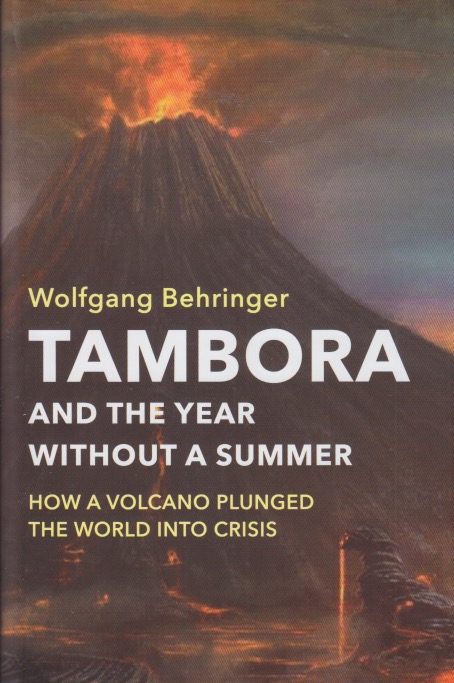
The name Wolfgang Behringer was familiar to me from his book Witches and Witch-Hunts, which I read several years back. I’ve been interested in volcanoes lately, and Tambora in particular. So when I saw his Tambora and the Year without a Summer I decided to indulge. What Behringer attempts here, as indicated by his subtitle, How a Volcano Plunged the World into Crisis, is a massive undertaking. The result is a rather rambling history that covers many of the troubles of the early nineteenth century, which, ultimately, were influenced by the crisis triggered by Tambora. For context, the eruption of Tambora in 1815, in what is now Indonesia, was the largest volcanic eruption in recorded history. It famously led to “the year without a summer” in many parts of the world, but, as the book points out, the effects were uneven. Western Europe was cold and wet. North America was cold and dry. Both of these situations led to famines and many people died.
Nature doesn’t play favorites, though. Weather is variable, and local. Eastern Europe, and Russia, experienced nearly ideal conditions for agriculture. There was enough food to go around, but what was lacking was the infrastructure. Western Europe was still putting itself together after the disruption of Napoleon and his wars. The Americans were still recovering from fighting off the British. And, being German, Behringer spends a lot of time explaining what was happening in Germany. Reading this kind of spurred me onto a little genealogy kick, since much of what he describes took place in the regions where my mother’s ancestors were from. That’s why I try to read widely—it has a Gumpian outcome, sometimes.
The inherent problem with a global history is that the world is simply too big, and human history too long and voluminous, to fit it all into one place. There were no doubt many crises caused by the atmospheric changes to which Tambora contributed. There were also many innovations. Behringer makes a good case that the Tambora crisis led to the development of meteorology as we know it. The regular and meticulous keeping of weather records began around then. Savings banks also emerged. As always, those who suffered the most from the famine were those who couldn’t afford food. In response, governments encouraged people to save up for a rainy day (or year). And the early development of life insurance, again to help people weather financial difficulties with the death of a wage earner, began. More about the crisis than the volcano itself, this is nevertheless, a chilling examination of how one crisis can change history.
 Steve A. Wiggins