
I’ve written before about that odd Ken Russell movie Gothic, one of my “old movies.” In case you missed it, the film is a fictional retelling of the gathering of Lord Byron, Percy Shelley, Mary Godwin, John William Polidori, and Claire Claremont in the summer of 1816. They read ghost stories to pass the time and decided to try writing them. Two famous stories came of it: Frankenstein and Polidori’s “The Vampyre,” a story that would go on to influence the genre. I hadn’t realized, being generally the one invited to someone else’s choice of film, that two years following Gothic a movie called Haunted Summer was released. Directed by Ivan Passer, it is a slow-paced romance that tells about the same meeting. It’s somewhat more believable than Russell’s movie, but it has some oddities. Perhaps the most telling is that it doesn’t mention the famous “contest” at all.
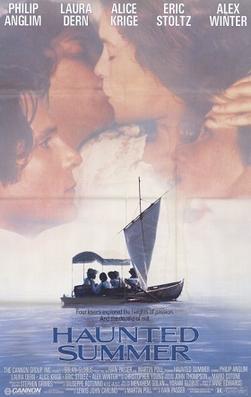
No doubt, one of the most compelling aspects of that summer meeting was the fact that a nineteen-year old Mary Godwin would go on to write one of the most influential fictional books of all time. The influence of Frankenstein is visible in most unexpected places. Internet personalities create “Franken” products by mixing together discrete products. (For example, “Frankensoap” is when you cut up and blend different soaps. You’ll actually find Frankensoaps in our bathrooms at the moment since that’s the way I handle soap scraps. Soap never seems to go fully away before it becomes unusable.) Frankenstein influenced everything from feminists to science fiction. Not to mention horror. Haunted Summer, however, although it has Polidori as a character, doesn’t mention his story at all. It really focuses on the sexual tension between Byron and Mary Godwin.
Our imagination of that meeting of two famous writers and one soon-to-become famous one, often doesn’t make room for the fact that Shelley and Godwin were actually traveling with their infant son William—not shown in the movie. (Mary had delivered a premature daughter the year before, who didn’t survive.) I suppose putting a baby in the mix might, in Puritan America, dampen the romance implied in Haunted Summer. Both that movie and Gothic make use of Henry Fuseli’s painting “The Nightmare.” And although Haunted Summer isn’t a horror movie there are a few moments of fairly high tension—one when Godwin has her dream of the creature approaching her bed at Villa Diodati. The story, however, had already been told by Ken Russell’s movie and Haunted Summer failed to make much of an impact. That isn’t, however, quite the end of the story.
 Steve A. Wiggins