
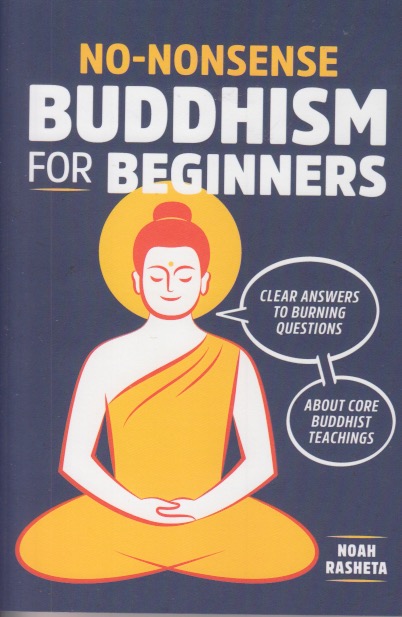
Refresher courses are a good idea. I learned bits of Buddhism from my undergraduate days as a student of religions on, but my specialization was in “western religions.” Those outside the field often don’t understand how technical religions can be. They require time to learn and learn about. I picked up a bit more Buddhism when I taught world religions, but still not enough to make me a specialist. As a religion editor I continue to learn more. My wife and I read Noah Rasheta’s No-Nonsense Buddhism for Beginners together. Buddhism is divided into two major branches with a third sizable one. Many would dispute that it is a religion since it has many aspects of a philosophy instead. Also, Buddhism is non-doctrinal—it’s a matter of outlook and what you do, not the specifics of what you believe. This book is a handy introduction, or refresher course.
The concept of religion itself developed because of the exclusive truth claims that grew from the Abrahamic traditions (Judaism, Christianity, and Islam). The declaration that other belief systems are wrong—each of these traditions grew amidst what we might consider folk religions today, labeled “paganism” as a way of disparaging them—led to the idea of what we believe being named “religion.” (Yours, of course, is the right one. Everyone believes that.) Buddhism remained largely unknown in the western world until the age of exploration, and in America was not really widely studied until the 1890s. As a way of looking at the world, it is older than classical Judaism, having begun in the sixth or fifth century before the Common Era. It follows, in large part, the teachings of Siddhartha Gautama, “the Buddha.”
Rasheta, the author of this book, is a secular Buddhist. He makes the point that Buddhism doesn’t displace one’s current religion but can be practiced alongside it. Being non-doctrinal it’s not a matter of which gods you believe in, if any. It certainly isn’t about worshipping the Buddha. A large part of it is mindfulness, and trying to avoid the traps that lead to suffering in human life. This book is set up in a question-and-answer format and is a straightforward introduction to what Buddhism is and how to begin to apply it to your life, if that’s what you wish. It’s difficult for those of us raised in the Christian tradition to get past the idea that the point of any religion is conversion. It’s not. Instead, Buddhism can be yet another tool to help deal with the suffering that life brings. Is it a religion? That’s a technical question.


2 thoughts on “Ordinary Buddhism”